

How U.S. Military Bases Around the World Undermine Real Global Peace
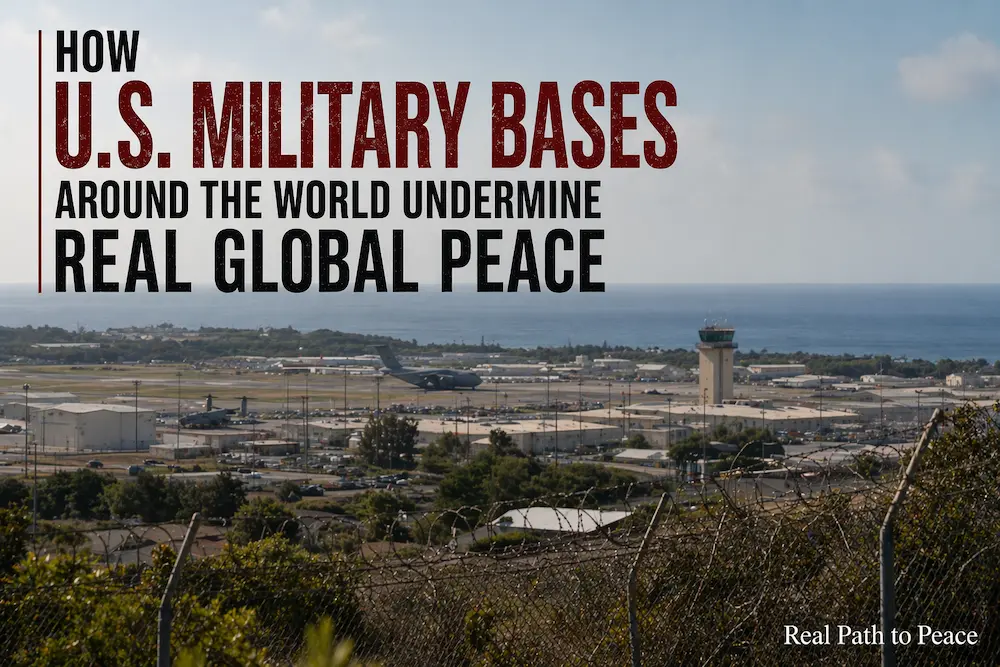
The United States maintains roughly 800 military bases across 80 countries. Washington claims these bases spread freedom and stability. But the truth looks very different.
Local communities face significant negative effects of U.S. military bases around the world. This global network blocks real peace instead of protecting it.
A Toxic Legacy That Lasts Generations
The environmental destruction from U.S. bases is staggering. PFAS contamination now appears at nearly 600 military sites worldwide. This chemical causes cancer and developmental disorders.
Local residents drink poisoned water. Children play on contaminated soil. No one cleans up properly. No one compensates these communities. Afghanistan offers a shocking example. Bagram Air Base burned 120 tons of waste daily. That toxic smoke contaminated 40% of Kabul’s water supply.
Over 8 million Afghans now breathe polluted air. Cancer and respiratory diseases keep rising. Doctors see young patients with illnesses typical of old age. Greenland tells the same story. The U.S. abandoned Camp Century with toxic waste inside. Climate change now melts the ice that buried it.
That waste threatens to leak into Arctic waters. Local people face damage they never caused. Washington accepts zero responsibility.
Communities Pay the Heavy Price
Living near a U.S. base means constant disruption. Jet aircraft shake homes at all hours. Sleep deprivation becomes normal for nearby families. Training accidents happen regularly. In Okinawa, a helicopter crashed into a university campus in 2024. No one died that day, but terror remains fresh.
Crime follows these bases everywhere. Military personnel commit theft, assault, and sexual violence. Local police often cannot arrest them due to special agreements. The US military bases imperialism peace equation becomes clear here. Host nations signed unequal treaties under pressure. They became dependent clients, not equal partners.
Okinawa shows this clearly. This small island hosts 70% of U.S. forces in Japan. Yet only 0.6% of Japan’s population lives there. Protests have surged for decades. Over 100,000 Okinawans recently signed a referendum petition. They want the bases gone. Washington simply ignores them.
A Global Movement Rises Up
Opposition to us military bases worldwide now has an organized network. The No-Bases Network connects 450 community campaigns globally. They share strategies and build solidarity. A farmer in South Korea learns from a fisherman in Diego Garcia. An activist in Germany supports a teacher in Guam. Borders do not stop this movement.
In February 2026, activists organized 49 protests across seven countries. World Beyond War led this global day of action. Thousands took to the streets on three continents. The International Conference Against US/NATO Military Bases recently met in Dublin. Over 300 activists from 35 countries attended. Grassroots campaigns sat as equal partners for the first time.
Cuban doctor Aleida Guevara addressed that conference. She called Guantánamo the first link in a worldwide chain of U.S. bases. Her words drew standing applause from the crowd. Even mainstream economist Jeffrey Sachs has spoken out. He said if no nation stationed foreign bases abroad, the world would become significantly safer. America’s 800 overseas bases represent unnecessary and dangerous excess.
Bases as Modern Outposts of Empire
The US military bases imperialism peace connection becomes undeniable with honest examination. Military bases today serve the same function as colonial outposts once did. They enable power projection without direct annexation. A country does not need to colonize another to control it. Just surround it with bases. Station troops nearby. Make clear that unwanted behavior brings consequences.
Many scholars call this network a new form of neocolonialism. The U.S. maintains global hegemony through unequal treaties. Host nations get dragged into conflicts they never chose. Consider the Philippines. U.S. forces operate from Enhanced Defense Cooperation Agreement sites there. When tensions rise in the South China Sea, American jets take off from Philippine soil. The local government often cannot say no.
The book A Real Path to Peace traces how U.S. warmongering operates consistently across regions. The patterns never change. Only the locations shift from Vietnam to Iraq to Ukraine.
A Different Path Forward Exists
The evidence proves these bases undermine peace rather than protect it. They poison land and water. They expose communities to violence. They drag sovereign nations into unwanted wars.
Alternative approaches to international relations do exist. The book Befriending China makes the case for people-to-people peacemaking. It argues that cooperation, not confrontation, offers a real path away from perpetual war. Trade, cultural exchange and diplomatic dialogue can replace military threats. Many nations live peacefully without foreign bases on their soil. The U.S. could learn from them.
Reflecting on a lifetime of activism, the memoir My Whirlwind Lives reminds us that change never comes from those in power. It comes from ordinary people who refuse to accept injustice. Anti-base movements grow stronger every year. Young activists now join veterans in demanding a different world. They organize protests. They file lawsuits. They build international solidarity. The momentum keeps building.
Conclusion
Closing U.S. military bases would not create a security vacuum. It would remove the root cause of much global instability. As the growing movement demonstrates, more people recognize this truth every day.
Real peace requires dismantling the infrastructure of the empire. One base at a time. One protest at a time. One conversation at a time. The path exists. The movement grows. Join it.
For an extended analysis, check out this detailed article on Are We Heading Toward World War 3 in 2026.
FAQs
Q: How many U.S. military bases exist worldwide?
A: The U.S. maintains roughly 800 military bases across 80 countries and territories.
Q: Do U.S. bases actually harm local communities?
A: Yes. Local communities face pollution, noise crime and health problems from nearby bases.
Q: What is the No-Bases Network?
A: It is a global movement connecting 450 community campaigns opposed to U.S. and NATO military bases.
Q: Can host countries say no to U.S. bases?
A: Most cannot. Unequal treaties and political pressure leave host nations with little real choice.
Q: What is the alternative to U.S. military bases?
A: Diplomacy, trade and people-to-people cooperation offer peaceful alternatives without foreign bases.
Leave a Reply