

How AI Could Change Global Conflict in 2026
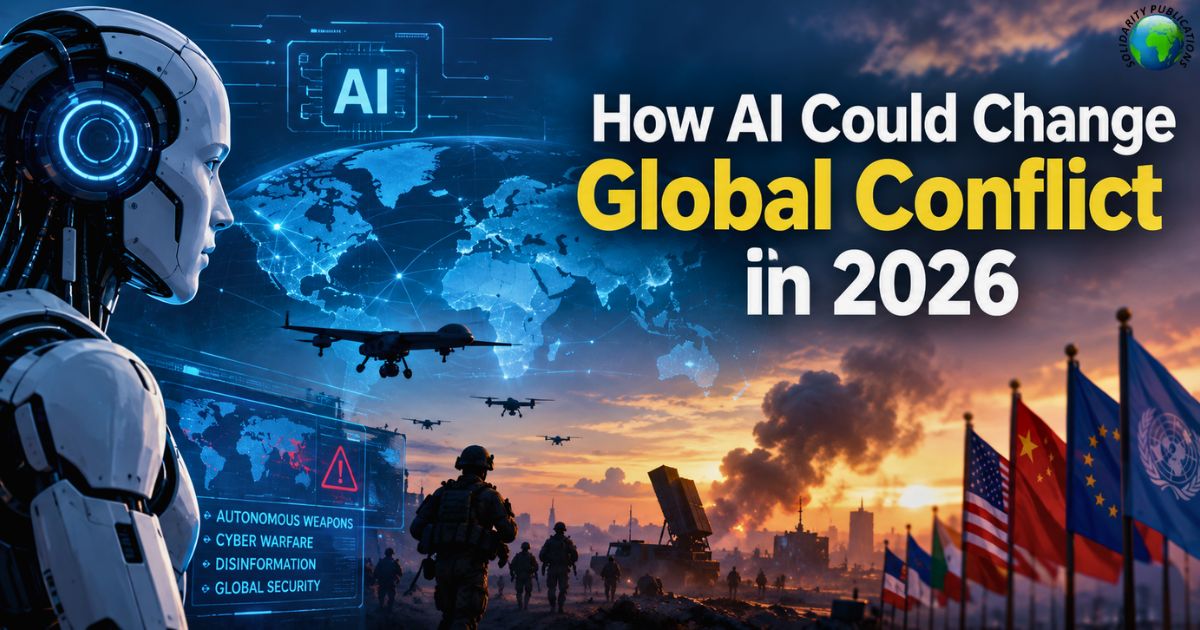
Artificial intelligence is changing how countries think about war, security, and power. What once seemed like science fiction now shapes military AI, intelligence systems, cyber defenses, and battlefield planning. This shift raises an important question: could AI and global conflict become more closely connected in 2026? For the United States, the answer matters because AI competition affects national security, military strength, and global influence.
At the same time, AI warfare could create new risks if machines act faster than human leaders can respond. From the AI arms race between major powers to growing cyber warfare, artificial intelligence may reshape how conflicts begin, spread, and end. Understanding these changes can help us prepare for a safer future.
Why AI Is Becoming a Global Security Issue
The rise of artificial intelligence has turned AI into a major national security issue. Governments can use advanced systems to analyze satellite images, track threats, study battlefield data, improve logistics, and support intelligence work. These capabilities give military planners more information than they could process manually. In a crisis, that advantage could become extremely valuable.
However, that speed also creates new risks. An AI system can produce a recommendation within seconds, but speed does not guarantee accuracy. Bad data can produce bad decisions. A system can also misread an unusual situation because its training data may not cover every possible scenario. For that reason, human oversight remains important when AI supports military decisions. The International Committee of the Red Cross warns that military AI can increase the pace and unpredictability of warfare while reducing human control. Read the ICRC’s guidance on AI in the military domain.
How AI Could Change Modern Warfare
Modern warfare already depends heavily on sensors, satellites, drones, software, and digital networks. AI could connect these pieces into a faster system for analyzing information and supporting decisions Military AI can help commanders sort information, identify possible threats, plan logistics, and understand changing conditions. Instead of studying thousands of reports separately, commanders could receive a clearer picture of what is happening on the ground.
The bigger change could come as machines begin operating with greater independence. AI-powered weapons and autonomous systems could detect objects, follow routes, or react to changing conditions with limited human input. That does not mean every military system will operate without human input. In many cases, people will still approve important actions. Yet the boundary between human judgment and machine-generated recommendations could become harder to define. CSIS notes that the software behind the military “kill chain” can now fuse sensor information, select targets, and influence decisions.
| AI capability | Possible military use | Main concern |
| Machine learning | Threat detection and intelligence | Incorrect predictions |
| Computer vision | Image and target analysis | Misidentification |
| Autonomous systems | Reconnaissance and operations | Loss of control |
| Generative AI | Planning and information analysis | False information |
| AI infrastructure | Large-scale military computing | Strategic dependence |
| Cyber AI | Network defense and threat detection | Faster and more complex attacks |
Could AI Create a New Arms Race?
The world has seen arms races before. The nuclear arms race remains one of the clearest examples. AI may create a different kind of competition because the technology has uses far beyond weapons. Countries can gain military, economic, intelligence, and industrial advantages from the same AI systems. That makes an AI arms race harder to separate from normal technological competition.
The pressure to move quickly could become especially strong among major powers. If one government believes another country has a major AI advantage, it may rush its own systems into service. That could reduce testing time and increase the risk of costly mistakes. The ICRC describes an arms race in emerging warfare technologies, including AI, while warning that these systems can increase risks for civilians.
The US-China AI Race and Global Power
The US-China AI competition is becoming an important part of wider geopolitical competition. The United States has major strengths in advanced computing, software, research, investment, and private technology companies. China has enormous manufacturing capacity, a large technology sector, strong state support, and the ability to connect AI development with industrial production. To understand China’s wider global role, see China’s Global Importance. Both countries also see advanced AI as strategically important.
That competition reaches beyond the battlefield. AI depends on chips, data centers, cloud computing, electricity, networks, talent, and supply chains. In other words, AI infrastructure is becoming an important source of national power. These dependencies also connect AI competition with resource competition, especially as countries compete for critical minerals, energy, and advanced computing infrastructure. For a broader look at these resource pressures, see How Resource Wars Could Shape Global Conflict in 2026. Recent U.S.-China discussions have also focused on AI safety and risks such as AI-directed cyberattacks. This shows that competition and cooperation can exist at the same time.
The stakes are particularly important for Washington because technology competition can affect alliances, trade, defense planning, and international relations. A major AI advantage could influence who sets technical standards and who controls critical technologies. These trade tensions can also reshape global supply chains and add another layer to wider geopolitical competition. For more context on these economic pressures, see How Trade Wars Could Shape Global Conflict in 2026. Reuters reported in September 2026 that the U.S.-China AI competition is closely tied to national security and technological power.
AI, Cyber Warfare and the Risk of Escalation
AI could make cyber warfare faster and more complex. Security teams can use AI to identify unusual network activity, search for weaknesses, and respond to threats. For a deeper look at this threat, see Cyber Warfare Biggest Threat to National Security 2026. Attackers can also use AI to automate parts of their operations. That creates a difficult race in which both defenders and attackers can respond faster.
The danger grows when cyber operations target critical infrastructure. Imagine a crisis involving two major powers. An automated system detects suspicious activity and reacts within seconds. The other side sees that response and assumes it was a deliberate attack. Leaders then receive incomplete information while pressure rises. This is one way conflict escalation could happen without either side initially wanting a wider war. The ICRC has warned that AI could increase the scale and severity of cyber operations against civilian infrastructure.
AI can also reshape the information battlefield. Misinformation, disinformation, and propaganda can spread quickly through automated systems. AI-generated images, videos, audio, and fake documents may make it harder for the public to know what is real. During a military crisis, that confusion could weaken public trust and make diplomacy more difficult.
Can AI Make Global Conflicts Harder to Control?
The most serious risk in AI and global conflict may not be a robot starting a war. It may be AI making an existing crisis move too quickly. Military leaders normally need time to gather evidence, consult experts, and compare options. An AI system can shorten that process dramatically. Faster decisions can help during emergencies, but they can also leave less time for human judgment.
There is another problem. AI systems can be difficult to explain. A commander may receive a recommendation without fully understanding why the system produced it. If several countries use similar systems, each side may also struggle to predict how the other will respond.
That uncertainty can weaken strategic stability. The FAS has highlighted the way AI is increasingly connected with cyber operations, military decision-making, and nuclear stability.
Can AI Help Prevent Future Wars?
AI does not have to be used only for military purposes. Used carefully, it could become a powerful tool for preventing conflict. Governments could analyze satellite imagery, troop movements, economic signals, and communication patterns to identify warning signs. Humanitarian organizations could also use AI to monitor damaged areas and identify urgent needs during conflicts.
The key is keeping people responsible for major decisions. AI could act like an early-warning system. It might tell diplomats that several warning signs are appearing at once. Humans could then investigate those signals and decide what action makes sense. Humans could then investigate those signals and decide what action makes sense. This approach could help support diplomacy without pretending that software can understand politics, culture, or human emotion perfectly. It could also support lasting peace and encourage stronger cooperation between countries.
This is another reason AI and global conflict should be understood as a security and peace issue, not only a technology issue.
Why the World Needs Rules for Military AI
Technology often moves faster than international rules. That gap is becoming an important issue for AI governance. Countries need clear expectations about testing, accountability, human control, and the use of autonomous military systems. Without common standards, governments may develop different rules and deploy systems that others cannot predict. These rules could shape how AI and global conflict evolve as military technology becomes more advanced.
International discussions are already moving toward clearer rules and stronger safeguards. In August 2026, the UN Secretary-General and ICRC President renewed their call for international rules on autonomous weapons. The ICRC has also called for restrictions on unpredictable autonomous weapons and systems designed to apply force directly against people.
| Area | Why rules matter |
| Autonomous weapons | Protect human control over lethal decisions |
| Military AI | Reduce errors and limit unpredictable behavior |
| Cyber operations | Limit attacks against civilians and essential services |
| AI testing | Find failures before deployment |
| Accountability | Make responsibility clear when systems fail |
| Data and models | Reduce manipulation and unreliable results |
Rules will not stop every conflict. They can, however, create guardrails that reduce the chance of catastrophic mistakes. International cooperation will be difficult because countries compete for technological advantages. Still, competition does not make cooperation impossible. Recent U.S.-China discussions on AI safety also show why communication channels can matter when broader relations remain tense.
What AI Could Mean for Global Peace in 2026
The future of AI and global conflict will depend less on the technology itself and more on how governments choose to use it. AI could improve intelligence, strengthen cyber defenses, detect warning signs, and support diplomacy. It could also increase military competition, accelerate cyber operations, spread false information, and reduce the time available for careful decisions.
For the United States, the challenge is balancing technological leadership with responsible development. Moving too slowly could create strategic disadvantages. Moving too quickly could create risks that are difficult to reverse. A balanced approach combines innovation with testing, transparency, accountability, and human oversight. AI should support better decisions while keeping meaningful human control over major actions.
Ultimately, AI and global conflict is not simply a story about machines replacing soldiers. It is a story about power, judgment, trust, and responsibility. The choices made today could shape international security for decades. If countries build useful safeguards while keeping communication open, AI could become more than a tool of competition. It could also support global peace and encourage stronger cooperation between countries in a rapidly changing world.
For that reason, understanding technology is now part of understanding peace itself. At Real Path to Peace, we examine these global challenges clearly and explore practical paths toward a safer world. The future may be shaped by powerful technologies, but human choices will still determine where that future leads.
Frequently Asked Questions
Q:1. How could AI change global conflict in 2026?
Answer: AI could make warfare faster by improving intelligence, cyber operations, targeting, logistics, and battlefield decision-making. It could also create new risks when systems act faster than humans can respond.
Q:2. Could AI create a new arms race?
Answer: Yes, AI could increase competition between major powers seeking military and technological advantages. Faster development and deployment could also increase the risk of errors and escalation.
Q:3. How is AI being used in modern warfare?
Answer: AI can analyze battlefield data, identify threats, support intelligence work, improve logistics, and assist military decision-making. Some autonomous systems can also operate with limited human input.
Q:4. Can AI increase the risk of cyber warfare?
Answer: AI can help both defenders and attackers work faster. This could make cyberattacks more complex and increase risks to critical infrastructure during international crises.
Q:5. Can AI help prevent future wars?
Answer: Yes, AI could help identify early warning signs, analyze satellite imagery, monitor conflicts, and support diplomatic efforts. However, major decisions still require meaningful human oversight.
Leave a Reply